UAE E-Invoicing Phase 1 and Phase 2: What Tally Prime Users Need to Do Now
📌 Executive Summary & Key Takeaways
- No Need to Replace Tally: You do not need to discard Tally Prime. The UAE mandate connects your existing software to an Accredited Service Provider (ASP) via automated data exchange.
- PDFs Are No Longer E-Invoices: Sending PDFs, Word files, or scanned receipts via email is not electronic invoicing under UAE law. A valid e-invoice is structured XML data sent via the Peppol PINT-AE network.
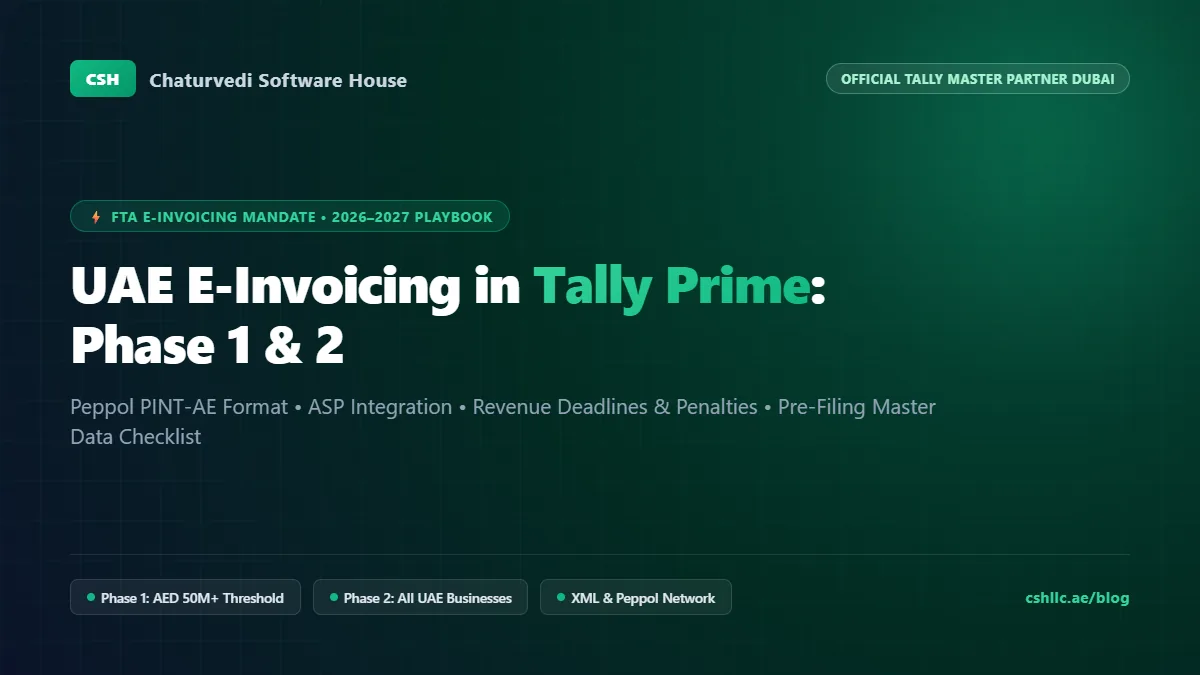
- Strict Phase 1 Deadline: Businesses with revenue ≥ AED 50M must appoint an ASP by 30 October 2026 and go live on 1 January 2027.
- Heavy Non-Compliance Cost: A recurring penalty of AED 5,000 per month applies for failure to appoint an ASP and integrate on schedule.
Quick Navigation • Practical Roadmap
If you still generate invoices as PDFs and email them to clients, that daily routine is about to change permanently. The United Arab Emirates is transitioning to mandatory nationwide electronic invoicing, and for many businesses the first regulatory deadline is right around the corner.
If your accounting and inventory run on Tally Prime, there is reassuring news: you do not have to replace your software. You do, however, need to connect Tally to the new national e-invoicing network and ensure your master data is completely clean. Here is what e-invoicing in Tally UAE actually involves, when each phase applies, and how to prepare without a last-minute scramble.
What Counts as an E-Invoice in the UAE?
This is where widespread confusion exists across finance teams. An e-invoice is not simply a billing document created on a computer screen.
A legally valid e-invoice consists of structured machine-readable data that business software can ingest and process automatically without manual re-keying.
In practice, the UAE standard utilizes XML structured according to the Peppol PINT-AE (Peppol International Invoice - UAE Extension) technical specification. You do not send this file straight to your customer over ordinary email. Instead, businesses within scope must appoint an Accredited Service Provider (ASP) to validate and transmit structured e-invoices through the UAE's Peppol-based Electronic Invoicing System.
A compliant Tally UAE e-invoicing architecture therefore comprises three core layers:
- Tally Prime: Where you record sales vouchers, credit notes, and purchase entries as part of daily operations.
- Accredited Service Provider (ASP): The certified intermediary that validates your voucher data, converts it into encrypted Peppol XML, and communicates with the national registry.
- The National Network & FTA: Transmits the authenticated invoice directly to your customer's ASP and automatically reports tax compliance data to the Federal Tax Authority.
Phase 1 and Phase 2: The Critical Timelines
The Ministry of Finance (MoF) is rolling out e-invoicing in structured phases determined by annual business turnover. The rollout begins with a Pilot Programme commencing 1 July 2026, alongside voluntary adoption for forward-looking organizations that choose early onboarding.
| Implementation Phase | Business Revenue Threshold | ASP Appointment Deadline | Mandatory Go-Live Date |
|---|---|---|---|
| Pilot Programme | Voluntary participants | Available Now | 1 July 2026 |
| Phase 1 | Revenue ≥ AED 50 Million | 30 October 2026 | 1 January 2027 |
| Phase 2 | Revenue < AED 50 Million | 31 March 2027 | 1 July 2027 |
| Government Entities | All B2G transactions | Mid 2027 | 1 October 2027 |
Mandate Scope and Non-Compliance Penalties
Two essential regulatory points are frequently misunderstood by UAE finance executives:
- Not Limited to VAT-Registered Companies: The e-invoicing mandate applies across taxable commercial entities, not merely those registered for 5% VAT.
- B2C Currently Excluded: Direct business-to-consumer point-of-sale transactions remain outside the initial mandatory scope, which focuses exclusively on B2B (business-to-business) and B2G (business-to-government) billing.
⚠️ Cost of Missing Deadlines
Under UAE executive tax regulations, an administrative penalty of AED 5,000 is imposed each month for every month the taxpayer fails to appoint an ASP and integrate the mandatory e-invoicing solution. Prolonged non-compliance can also halt tax refund processing and trigger FTA audits.
How Connected E-Invoicing Works with Tally Prime
With an integrated e-invoicing architecture in Tally Prime, your day-to-day bookkeeping remains familiar. Accountants continue entering sales vouchers and receipts as normal. The difference lies in the automated digital pipeline triggered upon saving:
Voucher Creation in Tally Prime
You generate the standard sales invoice, credit note, or debit note in Tally Prime exactly as you do today.
Encrypted Payload to ASP
Upon voucher authorization, the underlying accounting data is transferred securely via authenticated API connector to your selected ASP.
Data Validation & XML Formatting
The ASP validates tax computations, buyer TRN validity, and mandatory schema fields, converting the payload into Peppol PINT-AE XML.
Transmission via Peppol Network & FTA Reporting
The invoice traverses the secure Peppol network directly to your buyer's ASP, while statutory clearance data is simultaneously logged with the FTA.
Real-Time Status Synchronization in Tally
The network returns confirmation. Tally updates the invoice status to 'Acknowledged' or provides clear rejection diagnostics if errors occurred.
Two-Way Automation: This system functions identically in reverse for inbound procurement. When your vendors transmit e-invoices, they arrive via your ASP directly into your Tally Prime purchase register, eliminating manual supplier bill entry.
Why Peppol Matters for Tally Users
Peppol (Pan-European Public Procurement On-Line) is an internationally recognized standard, not a localized proprietary format. It governs e-invoicing networks across Singapore, Australia, New Zealand, Japan, and the European Union.
For Tally Prime users in the UAE, this framework provides significant advantages:
- Universal Interoperability: Your Tally invoices can reach any customer across the UAE or overseas, regardless of what ERP (SAP, Oracle, Microsoft Dynamics) they operate.
- High Security Standards: Peppol uses four-corner architecture with end-to-end transport-level security, ensuring invoice authenticity and tamper-proofing.
- Rigorous ASP Accreditation: The Ministry of Finance requires all certified ASPs to be active Peppol-certified Service Providers and maintain stringent cybersecurity controls.
Getting Tally Prime Ready: Where to Start
Most of the practical work in preparing for e-invoicing is not about software code—it is about data hygiene. If your Tally masters contain typos or missing tax information, the ASP will reject your invoices immediately. Follow this 5-step preparation roadmap:
What You Gain Beyond Compliance
While e-invoicing is a statutory requirement, it delivers tangible operational improvements to your accounting department:
- Elimination of Data Entry: Accounts payable teams no longer waste hours typing supplier invoices into Tally Prime.
- Zero Billing Disputes: Calculation errors and incorrect TRNs are caught by the ASP before transmission, eliminating invoice rejections by clients.
- Guaranteed Invoice Delivery: Digital acknowledgements confirm when clients receive bills, speeding up collection cycles and cash flow.
- Seamless VAT Reconciliation: The data in your quarterly VAT 201 return matches the FTA's central database automatically, drastically reducing audit risk.
Frequently Asked Questions (FAQ)
What counts as a valid electronic invoice under UAE law?
A PDF, Word file, scanned copy, image, or email invoice does not qualify as an e-invoice. A compliant e-invoice is structured machine-readable XML formatted according to Peppol PINT-AE standards, transmitted securely via an Accredited Service Provider.
Do I need to replace Tally Prime for UAE E-Invoicing?
No. Tally Prime remains your primary ERP and accounting solution. You only need to configure an integration connector to your chosen ASP to automate XML translation and Peppol transmission.
What are the Phase 1 and Phase 2 deadlines?
Phase 1 (turnover ≥ AED 50M): ASP appointment by 30 October 2026, go-live 1 January 2027. Phase 2 (turnover < AED 50M): ASP appointment by 31 March 2027, go-live 1 July 2027. Government entities follow on 1 October 2027.
What is the penalty for missing UAE e-invoicing deadlines?
Failure to appoint an ASP and implement compliant e-invoicing incurs an administrative fine of AED 5,000 per month for every month of non-compliance.
Are B2C transactions included in the UAE e-invoicing mandate?
No, business-to-consumer (B2C) sales are currently excluded from mandatory rollout. The mandate strictly applies to B2B and B2G transactions.
📚 Recommended Related Guides
Explore more step-by-step Tally Prime accounting and operations playbooks